


Integrating the Microbiome, Tumor Microenvironment, and miRNA in Pancreatic Ductal Adenocarcinoma- Toward Precision Therapies
Nazmi Özer
*

Department of Biochemistry, Faculty of Pharmacy, Girne American University, 99428 Girne, Mersin 10, Turkey.
Anwar Hmouz
Faculty of Pharmacy, Girne American University, Karmia Campus, 99428 Girne, Mersin 10, Turkey.
*Author to whom correspondence should be addressed.
Abstract
Pancreatic ductal adenocarcinoma is a highly aggressive malignancy characterized by late diagnosis, rapid progression, and poor survival outcomes. Despite its higher incidence in older men, typically between the ages of 60 and 85, rising rates among younger populations and an incompletely understood etiology underscore the need for improved mechanistic insights and therapeutic strategies. Early detection remains challenging due to the lack of reliable biomarkers, and although surgical resection offers the only curative option, fewer than 20% of patients present with resectable disease. Current standard treatments rely primarily on chemotherapy, often combined with radiotherapy or surgery, but the overall prognosis remains poor. This review synthesizes and critically evaluates emerging therapeutic approaches for pancreatic ductal adenocarcinoma, focusing on immunotherapeutic strategies, tumor microenvironment modulation, microbial-based interventions—including fecal microbiota transplantation and dietary modification—and microRNA (miRNA)-targeted diagnostics and therapeutics. Particular attention is given to the role of the tumor microenvironment in mediating immune resistance and shaping therapeutic responses.
Growing evidence highlights the influence of the microbiome, modulated by factors such as diet, obesity, and smoking, on pancreatic ductal adenocarcinoma progression and treatment efficacy. Integrating microbiome research with immunogenomic approaches presents novel therapeutic opportunities, although challenges such as donor selection and the optimization of microbiota-based therapies persist.
By elucidating mechanistic interconnections among these modalities, this review assesses their translational potential and proposes integrative frameworks for future clinical development. Comprehensive strategies incorporating tumor microenvironment modulation, microbiome-based interventions, cancer stem cell targeting, and miRNA therapeutics within adaptive clinical trial designs are essential to advance precision medicine and improve patient outcomes in pancreatic ductal adenocarcinoma.
Graphical Abstract
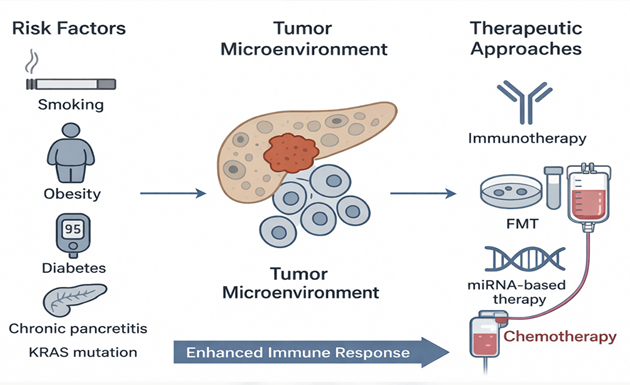
Challenges, emerging opportunities, and comprehensive therapeutic approaches in pancreatic ductal adenocarcinoma (PDAC).
Keywords: Pancreatic cancer, pancreatic ductal adenocarcinoma, high-risk factors, tumor microenvironment, immunotherapy, fecal microbiota transplantation, miRNA therapy