


Drug Dissolution Studies in Pharmaceutical Formulations: Mechanisms, Influencing Factors, and Regulatory Perspectives
Dickson Pius Wande
*

Department of Pharmaceutics, School of Pharmacy, Muhimbili University of Health and Allied Sciences, Dar es Salaam, Tanzania.
*Author to whom correspondence should be addressed.
Abstract
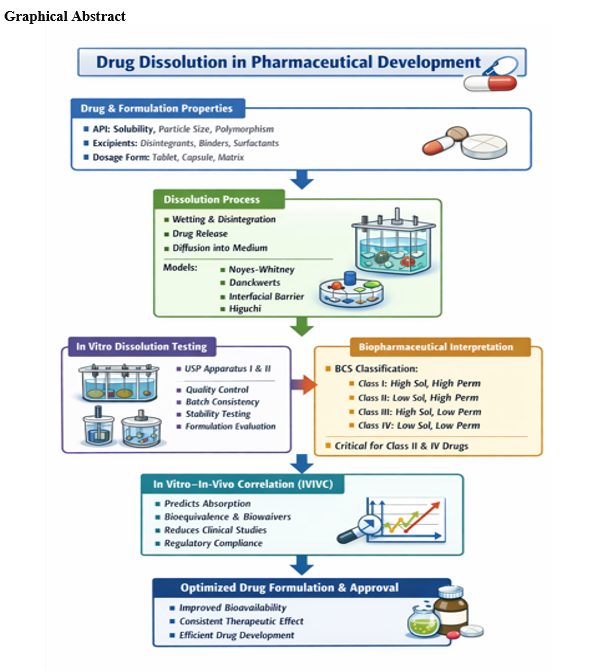
Assessing dissolution is essential for many pharmaceuticals that lack suitable solution forms. Drug dissolution testing plays a central role in pharmaceutical development, quality control, and regulatory evaluation of oral dosage forms. This review provides a comprehensive overview of the theoretical foundations, mechanistic principles, and practical considerations governing drug dissolution in pharmaceutical formulations. Fundamental mathematical models describing dissolution kinetics are discussed, including the diffusion-layer–based Noyes–Whitney equation, the Hixson–Crowell cube-root law, Dankert’s surface-renewal model, and the Takeru Higuchi model for matrix-based systems. These models provide critical insights into diffusion-controlled, interfacial, and matrix-mediated drug-release mechanisms.
Key physicochemical factors influencing dissolution—such as solubility, particle size, salt formation, polymorphism, and solid-state characteristics—are examined alongside formulation variables, processing parameters, and dissolution test conditions, including agitation, temperature, medium composition, and surfactant effects. The review addresses both immediate-release and modified-release dosage forms, highlighting differences in release mechanisms and the specific challenges associated with poorly soluble compounds, particularly those classified under the Biopharmaceutics Classification System.
Furthermore, the importance of establishing in vitro–in vivo correlation (IVIVC) is discussed. IVIVC models serve as predictive tools linking in vitro dissolution data to in vivo performance and support regulatory applications such as bioequivalence assessment, biowaivers, post-approval changes, and Quality by Design (QbD) strategies.
Overall, dissolution testing remains an indispensable tool in pharmaceutical sciences, bridging formulation development, mechanistic understanding, and regulatory decision-making to ensure the safety, efficacy, and quality of drug products.
Keywords: Pharmaceutical development, dissolution profile, In-vitro-In-vivo correlation, pharmaceutical quality, regulatory decision-making